Sunday, 31 July 2011

Stuffed Banana Peppers

This recipe is the first in this blog that comes from The Indian Vegan Kitchen - a great cookbook that I recently got with lots of authentic, flavourful recipes. Banana peppers are mild, but the filling used in this recipe is very spicy, so beware ;)

Stuffed Banana Peppers

8 banana peppers
2/3 cup besan (chickpea flour)
1/3 cup dry-roasted unsalted peanuts, coarsely ground
1/8 asefetida powder (or 1/2 teaspoon garlic powder)
1 teaspoon cumin seeds
1/2 teaspoon turmeric
1 teaspoon salt
2 teaspoons ground coriander
1/2 teaspoon cayenne pepper, or to taste
2 teaspoons lemon juice
1 tablespoon & 1 teaspoon oil, seperated
1/3 cup water

Wash and dry the peppers. Make a slit on one side from the stem end to the tip of the peppers, making an opening. Do not cut through the peppers. Set aside.

In a small bowl, mix together besan and ground peanuts. Add asefetida/garlic powder, cumin seeds, turmeric, salt, coriander, cayenne pepper, and lemon juice. Mix well. Add 1 teaspoon of the oil and the 1/3 cup water into the mixture, making it crumbly. The mix will be thick and sticky.

Fill the peppers with batter. Using your thumbs to pry them open, add the batter, and with a finger spread the batter evenly into the opening. Fill the peppers about half full with batter. (Besan batter is sticky and hard to work with - some of it might stick to the outside of the pepper, but try to avoid it.)

Heating the remaining 1 tablespoon of oil in a largey nonstick fry pan on medium-high heat. Add the stuffed banana peppers in a single layer, filled side up. Cover up with lid and cook for 5-6 minutes until the peppers are tender (they change colour and appear transparent; the besan filling will harden and fill the peppers). Turn the peppers occasionally using tongs, making sure to evenly brown all sides. Remove the lid and cook for another 2 minutes, turning occasionally.

Using tongs, transfer peppers to a serving dish. Discard any remaining oil.


Serve with a stew or lentil curry.

Friday, 29 July 2011

Tofu & Red Cabbage Dumplings

I had some red cabbage left over from the Kale Borsch that I made last week, and was wondering what I could do with it, when I suddenly remembered a dumpling recipe that I had used a few years ago. Traditional Chinese dumplings are made with napa cabbage and ground pork, but crumbled tofu works just as well. Using red cabbage adds some extra colour to the dish.

Tofu & Red Cabbage Dumplings

2 tablespoons & 2 tablespoons oil, seperated
2 teaspoons ground ginger
1 tablespoon soy sauce
1 teaspoon cornstarch
4 scallions, chopped, green parts only
150g firm tofu, crumbled
1.5 cups red cabbage, shredded
2/3 cup white or brown mushroom caps, sliced
30 round (eggless) wonton wrappers
1/4 cup (60ml) water
Salt, to taste

In a saucepan, heat 2 tablespoons of the oil and sauté the scallions for about 1 minute over medium heat. Add the mushrooms, cabbage, scallions, and tofu. Turn to high heat and stir-fry for 2-3 minutes. Add the soy sauce and salt (if using) and continue to stir over high heat for another 2-3 minutes until the excess liquid has been absorbed. Sprinkle in the cornstarch and ginger and mix quickly. Trasfer to a dish to cool.


Put 1.5 teaspoons of the vegetable mixture in the center of each wonton wrapper and moisten the edges of the wrapper with water. Fold to make a moon shape, making a few pleats to seal:


Heat 1 tablespoon of the remaining oil in the saucepan and put in half of the dumplings. Cook both sides for ~2 minutes over medium heat until well browned; then repeat with the remaining dumplings and the remaining 1 tablespoon of oil. Transfer to a dish and serve with dipping sauce of your choice.


Serve alongside tofu soup, a stir-fry or a rice/noodle dish.

Thursday, 28 July 2011

Quinoa Temaki

My apologies for not posting for a few days - I'll be posting several recipes in the next 2-3 days or so, so hopefully that'll sort of make up for it.

Temaki (手巻き, or hand rolls)  are small, cone-shaped snacks of rice and other ingredients wrapped in nori (seaweed) sheets. The following recipe, from Quinoa 365 (a somewhat vegan-friendly cookbook that's great for quinoa lovers) puts a twist on this traditional Japanese appetizer by replacing white rice with quinoa - a grain that's high in iron, zinc, fiber, B-vitamins, phosphorus, and has a complete protein profile (ie. it has all of the essential amino acids [proteins] needed by the human body). Combined with seaweed (rich in iodine) and other vegetables, this recipe packs a powerful nutritional punch.

Serve with miso soup, boiled edamame, vegan tempura and other Japanese dishes for a complete meal.

Quinoa Temaki

2 cups water or broth
1 cup quinoa
6 tablespoons rice vinegar
1.5 teaspoons agave nectar
1/4 teaspoon salt
10 sheets of nori, each one cut in half with scissors
1 avocado, sliced into 20 strips
100g enoki mushrooms
~40 thin strips of cut cucumber
2 tablespoons (30ml) black or white toasted sesame seeds
Tamari or soy sauce
1/4 cup (60ml) thin carrot strips (optional)
1 tablespoon slicked pickled ginger, cut into thin strips (optional)
Wasabi (optional)

Bring the water/broth and quinoa to a boil in a medium saucepan. Reduce to a simmer, cover and cook for 10 minutes. Turn the heat off and leave the covered saucepan on the burner for another 10 minutes to allow residual heat in the pot to continue cooking the quinoa to an extra-plump texture. Fluff with a fork and set aside.

Meanwhile, heat the vinegar, agave nectar and salt in a small saucepan or in the microwave until the mixture is warm and the agave and salt are dissolved. Stir the vinegar mixture into the warm quinoa until evenly distributed. Allow the quinoa to cool to room temperature in the uncovered pot.

Making sure your hands are dry, place 1 piece of nori on a cutting surface with the rough side facing up. Place 2 tablespoon (30ml) of the quinoa on the left hand of the nori and spread slightly, leaving 1/2-inch (1cm) border around the edges. Add a a strip of avocado, 2 strips of cucumber, and 2 pieces of enoki mushroom (and carrot strips, if using).

Take the bottom left corner of the nori and bring it up to the center top. Keep rolling it around until the nori forms a cone. Using your finger dipped in water, moisten the inner edge of the nori and press gently together to seal. Sprinkle the top of each temaki with a few sesame seeds.

(For more info about how to roll temaki, check out this video.)

As you are putting the temaki on a plate or platter, place a weight (such as the edge of a saucer) on the side of the nori to hold down the edges until set. Repeat with the remaining ingredients.

Serve the temaki immediately. Serve tamari or soy sauce and wasabi (if using) on the side.


Makes 20 temaki.

Disclaimer: I'm not very crafty with my hands, and my temaki aren't very neat/pretty. Yours will look much better ;-)

Sunday, 24 July 2011

Thai Pumpkin Curry

The following is another recipe from The Tropical Vegan Kitchen - a very underrated book that I would recommend to anyone and everyone. It's an excellent book full of relatively simple, whole foods-based recipes that are delicious, but because the book does not have any pictures, and because I think it deserves more recognition than it currently receives, I will occasionally upload recipes & pictures from it.

The following is a very orange-y, delicious Thai curry, rich in beta-carotene. Serving it with quinoa adds some extra iron; brown rice, on the other hand, is a great source of selenium. Feel free to also use a mix of grains as a bed for the curry.


Thai Red Curry Sauce:

1 can light coconut milk
2 shallots, chopped
Juice of 1 medium orange
2 tablespoons soy sauce
Juice of 1/2 lime
1 tablespoon plain rice vinegar
1 teaspoon ground cumin
2 teaspoons sugar
2 teaspoons Thai red curry paste
1/2 teaspoon ground turmeric
salt, to taste

In a food processor fitted with the knife blade, or in a blender, process all ingredients until well blended. Use as directed in recipe. Mixture can be stored, covered, in fridge up to 3 days.


Makes 2-2.5 cups.
~

Thai Pumpkin Curry:

Thai Red Curry Sauce (above)
1.25lbs cubed, seeded, & pee;ed cpplomg pumpkin or butternut squash
1 medium sweet potato (cooked), peeled & cut into pieces
1 medium bell pepper, cut into 1/2-inch cubes
2 cups cooked chickpeas (=1 can), rinsed
4.5 cups cooked brown rice, quinoa, or other whole grain(s) of your choice
4oz (1/2) baby carrot, sliced
1 tablespoon fresh orange peel, shredded (optional)
Fresh basil leaves, for garnish (optional)

In a large deep-sided skillet with a lid, bring the curry sauce, squash, potato and carrots to a boil over medium-high heat, stirring occasionally. Reduce the heat to medium, cover, and simmer until the vegetables have softened, about 10-12 minutes, stirring occasionally. Add the bell pepper, chickpeas, and orange peel; cook, covered, stirring occasionally, until all the vegetables are tender, about 6 minutes. Uncover and cook, stirring occasionally, until the mixture is slightly reduced, about 3-4 minutes. Serve warm, over the rice/quinoa.etc, garnished with the basil (if using).


Thai Pumpkin Curry, served with quinoa.

Saturday, 23 July 2011

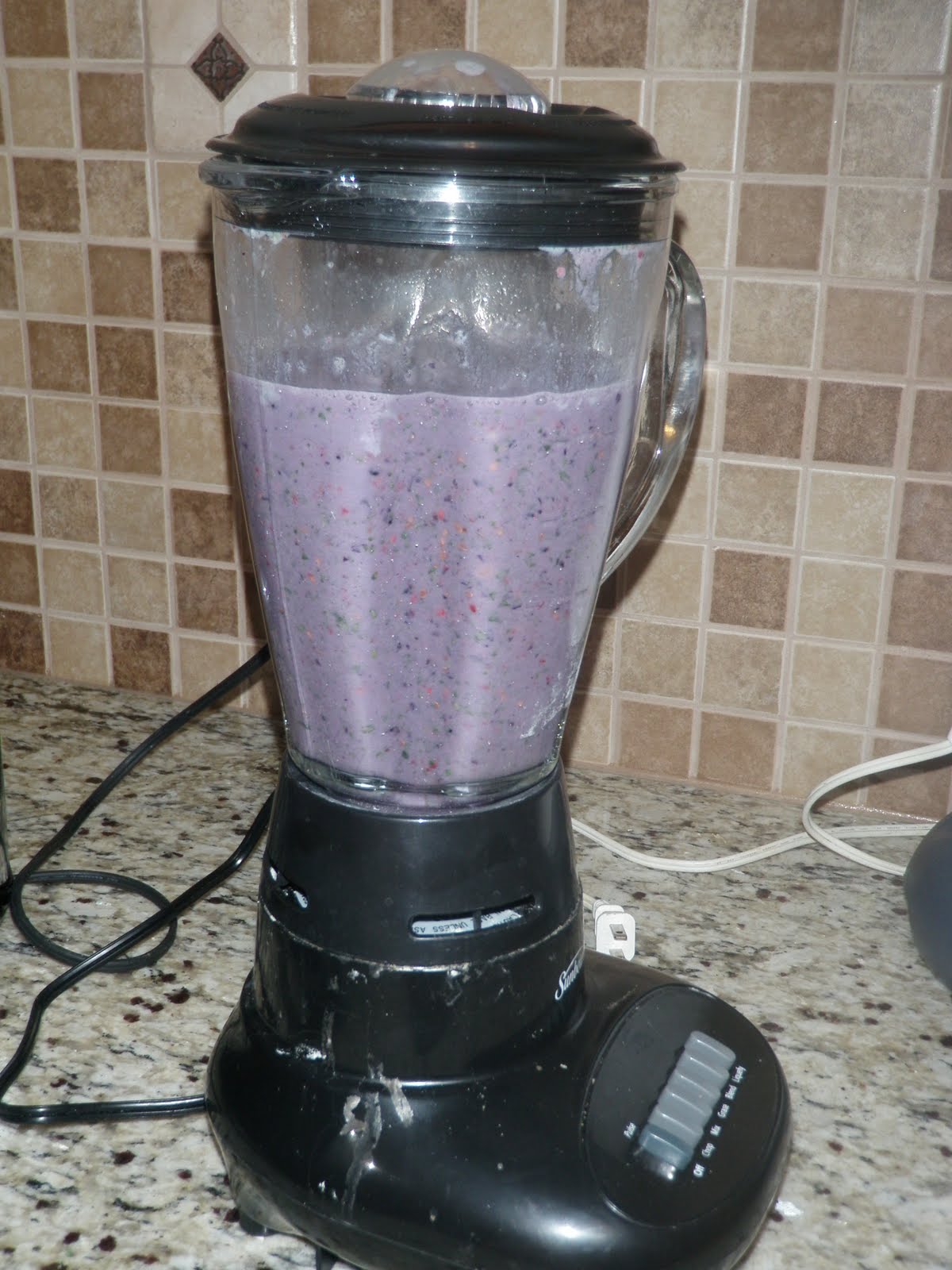
Maya's Purple Smoothie

As a jogger, I often make a smoothie after a jog to re-hydrate and get some vital nutrients (calcium, potassium etc) in. Berries in particular are extremely rich in antioxidants, fiber, and vitamin C.

Since my green smoothie seems to be one of the more popular posts on this blog so far, I thought I'd share another colour variation of this smoothie. Enjoy :)

~Maya's Purple Smoothie~

1.5 cups raw baby bok choy, chopped
1 cup cold, sweetened soy milk
1 cup cold water, & a few ice cubes
1 medium banana, peeled & sliced
1/3 cup blueberries
1/3 cup raspberries
1/4 cup blackberries
2 tablespoons chia or flaxseeds
1 tablespoon maple syrup (optional)


Mix everything together in a smoothie mixer, and enjoy :)

Thursday, 21 July 2011

Kale Borsch

Borsch is a classic Russian soup made from beets and red cabbage. The beets are boiled in the soup for a long time, allowing their deep red colour to "bleed out" into the soup, giving it its characteristic purple-red colour. The deep colour in beets comes from an antioxidant known as betalain, which has strong immune-enhancing and anti-carcinogenic properties; beets are also a good source of vitamin C, folate (vitamin B9), potassium and manganese.

This version of mine is made with kale, adding extra calcium and even more antioxidants into the mix.

Like all borsch, this verison should be served cold in the summer and hot in the winter.


4 green onions, chopped (green parts)
Handful of fresh dill, chopped
1 teaspoon olive oil
2 teaspoons lemon juice
6-7 cups broth
2 cups red cabbage, shredded
1.5 cups cooked or canned (= 1 can) beets, with juices
2 cups raw kale, chopped thinly
3 medium potatoes, peeled & sliced (optional)
Cilantro, as garnish (optional)
Salt, to taste

In a deep, wide pot, heat up the olive oil and lemon juice and add the green onions and dill, allowing to heat for ~30 seconds, then turn down to medium heat. Add 5.5 cups of the broth along with the beets, cabbage, and kale, turning back up to high heat until the soup boils. Simmer on medium-low heat, adding the remaining broth (and potatoes, if using), then turning back up until it boils a second time.

Once it boils the second time, simmer on medium-low heat, 20-25 minutes, covered, until the vegetables (and the cabbage in particular) is thoroughly cooked and soggy.

Turn the heat off and allow to cool down (or serving immediately if serving during the winter).


Serve with cilantro and/or salt, as desired.

Wednesday, 20 July 2011

Potato-Cabbage Casserole

Contrary to what our carbophobic, meat-crazed society would have you believe, potatoes are actually a good, healthy food.

For one thing, they are not nearly as calorie-dense as you might think. A whole, extra-large potato (here we are talking about something larger than what most people would eat in a single serving) only has around ~200 calories, which is nothing if you consider how filling such a serving would be. Furthermore, potatoes are packed with nutrients. Even a medium-sized potato is loaded with vitamin C, thiamin (vitamin B1), niacin (vitamin B3), vitamin B6, pantothenic acid (vitamin B9), magnesium, phosphorus, potassium, copper, and manganese.

And yeah, they're loaded with carbs - but so what? Carbs are important for human health; they're the primary source of fuel for our brains. Potatoes are also rich in fiber, which promotes digestive health and is beneficial for long term health.

There is, of course, a danger in eating a lot of potatoes that are fried, or that have been smothered in fattening dairy products. Nor should we eat only potatoes at the exclusion of other foods. But not only is occasionally enjoying potatoes not bad for you; it's actually good for you.

This is a recipe I invented myself; it's light, low-fat, high-fiber, and nutrient-dense. Served with cabbage (another healthy food) and a tomato sauce, this recipe uses simple, easy-to-find ingredients and is therefore realtively easy and convenient to make.


Ingredients (for the casserole)

1.5lb potatoes (about 6 medium)
1-1.5 cups chopped green cabbage
3/4 cup cauliflower florets
1 cup whole wheat bread crumbs (equivalent to crumbs of 2 slices of bread)

Ingredients (for tomato sauce)

1 tablespoon olive oil
6 stalks green onions, chopped thinly (green parts only)
1/2 tablespoon lemon juice
2 cans whole tomatoes, with juices, each tomato cut in half
2 teaspoons dried oregano
1/2 cup broth


Preheat oven to 400°F.

Peel the potatoes and cut them into flat slices, and boil them in water, until they are soft, about 15-20 minutes. While the potatoes are cooking, put the cabbage and cauliflower into a shredder and shred lightly for 30 seconds (the vegetable pieces should be chunky but not too mushy).


In a large, deep pan, heat the tablespoon of olive oil and add the green onions, stirring for 30 seconds to a min, until slightly browned; add the oregano and 2 cans of tomatoes with their juices. Allow to simmer uncovered for 12-15 minutes, until the sauce has thickened and reduced somewhat. (Make sure to check on / stop boiling the potatoes in the mean time, draining the water and setting them aside.)

In a deep casserole dish, pour out about a quarter (1/4) of the tomato sauce and lay 1/2 of the flat potato pieces on top, so that the potatoes are more or less covering the bottom.


Pour on top 1/2 of the shredded cabbage-cauliflower mixture (use a spoon to even out if necessary) and top with 1/2 of the bread crumbs. Top with the remaining 1/2 of the potato slices, followed by the remaning 1/2 of the shredded mixture and the final 1/2 cup bread crumbs. Pour the remainder of the mixture over top.

Bake for 35-40 minutes, or until the top has just slightly browned.


Serve with a side of bean soup or lentil burger for some iron.